Quickswap liquidity pools distribute trading fees through V2 shares and active V3 positions
Quickswap liquidity pools hold the token reserves that swaps use and distribute trading fees to liquidity providers. V2 providers own proportional pool shares, while V3 providers choose price ranges that determine when their liquidity earns fees. Additional farm rewards apply only to eligible positions. Choosing a pool involves its token pair, fee rules, range requirements, and withdrawal mechanics. Fees can increase a position’s value, yet changing token balances can leave it worth less than holding the original assets.
UpdatedDeposit Terms and Position Creation
A liquidity deposit requires the selected chain, token contracts, pool version, and spending permissions to match, because those choices determine which contract receives the assets and which position the deposit creates. V2 deposits follow the existing pool’s reserve ratio. The two contributions have equal value at the pool price, which usually means different token quantities. Direct V3 deposits follow the chosen range and current pool price. Available token balances must cover that composition, and the wallet needs funding for its selected network-fee method. A proposed deposit can change before confirmation if the price moves.
A spending approval grants access to specified tokens; it does not create an LP position. The completed liquidity transaction establishes or increases the pool share or range position. Its contract record identifies the underlying pair and liquidity. Minimum-amount conditions limit the price movement that the deposit accepts. The wallet holds the position receipt, while pool contracts hold the supplied assets. A contract failure can affect deposited assets even when the wallet still displays its receipt.
Pool Shares and Range Positions
V2 pool tokens represent proportional claims on a pool’s reserves, while direct V3 position NFTs identify liquidity assigned to a particular price interval. The receipt determines how ownership and earnings appear. V2 pools hold two tokens under a constant-product model. Their reserve relationship is commonly written x × y = k, where x and y denote token balances. Swaps change those balances, and retained fees increase the reserves that pool shares represent.
A non-fungible token, or NFT, records an individual direct V3 position. A managed V3 strategy can instead issue fungible receipts for a shared strategy. These receipt types need compatible farming and withdrawal arrangements. Deployment names also matter: Quickswap uses Algebra V3 contracts on Polygon PoS and Algebra V4 contracts on Base. A V3 fee description does not establish the settings of every concentrated-liquidity deployment.
Fee Allocation and Active Liquidity
An LP earns a share of the fees allocated to providers, so the pool’s total swap charge and the LP’s allocation must remain separate when estimating income. For V2, the provider’s share is its LP-token balance divided by total LP-token supply. That share applies to the portion of fees that accrues to LPs. Other deposits or withdrawals can change the share. The original Polygon PoS V2 pair contracts charge 0.3% of the input amount for ordinary swaps. Protocol fee sharing can reduce the allocation retained by LPs without changing that swap charge.
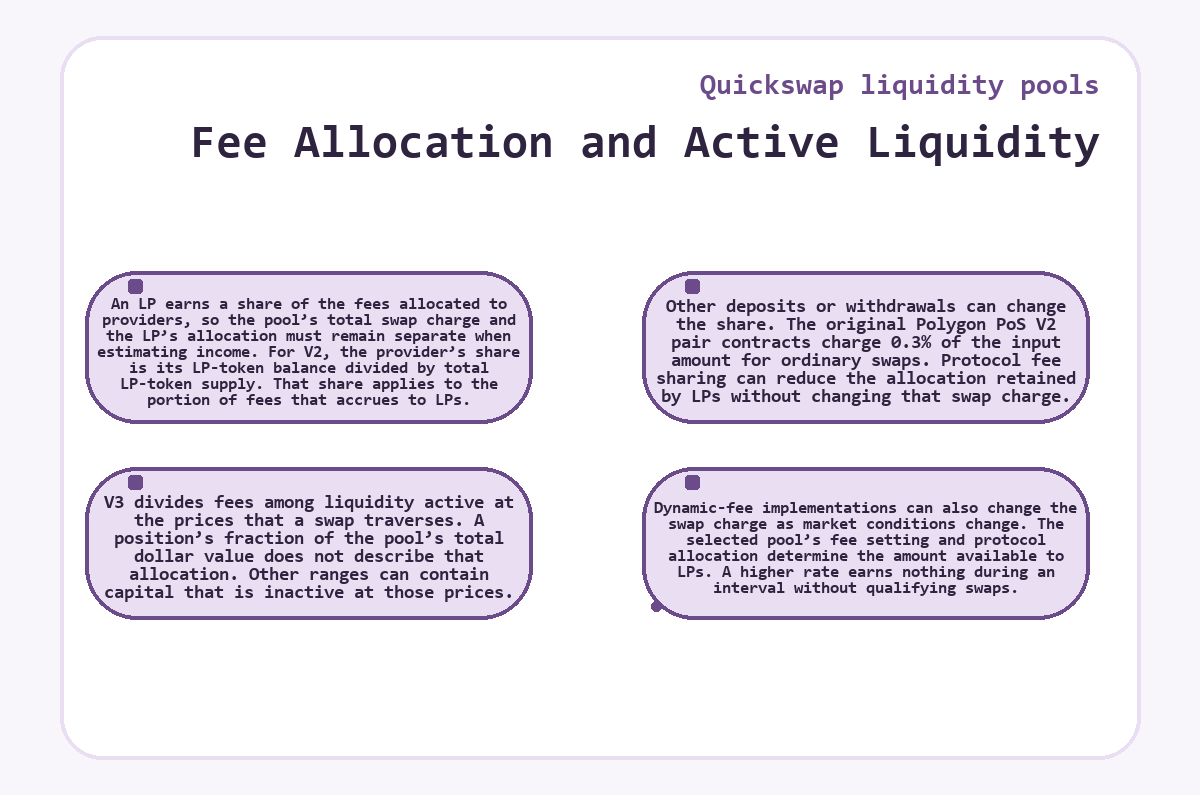
V3 divides fees among liquidity active at the prices that a swap traverses. A position’s fraction of the pool’s total dollar value does not describe that allocation. Other ranges can contain capital that is inactive at those prices. Dynamic-fee implementations can also change the swap charge as market conditions change. The selected pool’s fee setting and protocol allocation determine the amount available to LPs. A higher rate earns nothing during an interval without qualifying swaps.
Range Width and Token Balance Changes
Range width controls where a V3 position supplies liquidity: narrowing the interval concentrates capital, while widening it spreads that capital across more possible prices.
A direct V3 position earns swap fees only while the pool price lies within its selected range. Within that interval, swaps change the position’s token quantities as the relative price moves. At a boundary, its principal can consist entirely of one asset. Which asset remains depends on the price direction and the pair’s quotation order. Previously earned fees remain separate from that principal composition.
Full-range V3 liquidity still follows V3 fee accounting; a broader interval does not turn its receipt into a V2 pool share.
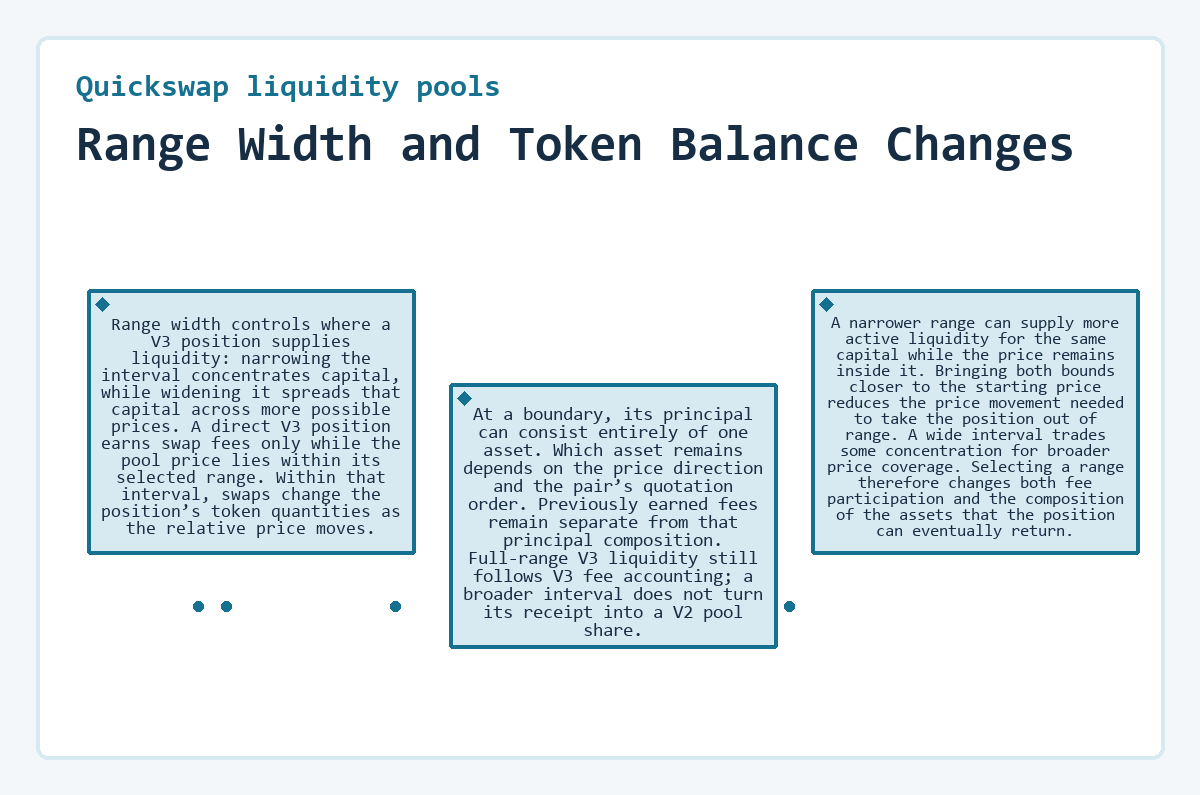
A narrower range can supply more active liquidity for the same capital while the price remains inside it. Bringing both bounds closer to the starting price reduces the price movement needed to take the position out of range. A wide interval trades some concentration for broader price coverage. Selecting a range therefore changes both fee participation and the composition of the assets that the position can eventually return.
Does Staying in Range Prevent Impermanent Loss?
An in-range V3 position can underperform holding because trading changes its token quantities even before the price leaves its bounds. Impermanent loss is the relative loss caused by a pool’s changing token composition compared with holding the original tokens. It concerns relative performance, not simply whether the position’s dollar value rose or fell. Fees and incentives can offset that difference, but their value needs separate accounting.
Compare both alternatives over the same interval. Position value uses current underlying balances; holding value uses the original quantities. Include earned fees or rewards separately only when the position value does not already include them. Account for distributed amounts without counting the same proceeds twice. Deposit, management, and exit expenses also affect the LP outcome. A profitable fee stream can coexist with a shortfall against holding.
Fees and Position Value After Price Movement
Consider a hypothetical comparison of V2 liquidity and a direct V3 position funded with the same original token quantities. All dollar values and costs here are invented observations at the same later prices. Holding those quantities would be worth $1368. The V2 share represents $1336, including accrued pool fees, with $7 in transaction costs. The in-range V3 principal is worth $1317, with $38 in uncollected fees and $9 in transaction costs.
V2’s net value is $1336 - $7 = $1329, which trails holding by $39. V3’s net value is $1317 + $38 - $9 = $1346, which trails holding by $22. Both calculations count fee income once.
If the V3 price moves outside its selected range, the position stops accruing new swap fees. Earlier fees remain claimable. Fee earning can resume for subsequent swaps when the price returns or liquidity enters a suitable new range. Repositioning changes future exposure and may add costs; it does not erase the earlier shortfall.
Check the calculation against the underlying position balances and separately accrued fees, pricing both alternatives at the same moment. The V2 redemption value already includes its reserve-based fees. Adding those fees again would falsely improve the comparison.
Withdrawal Amounts and Fee Collection
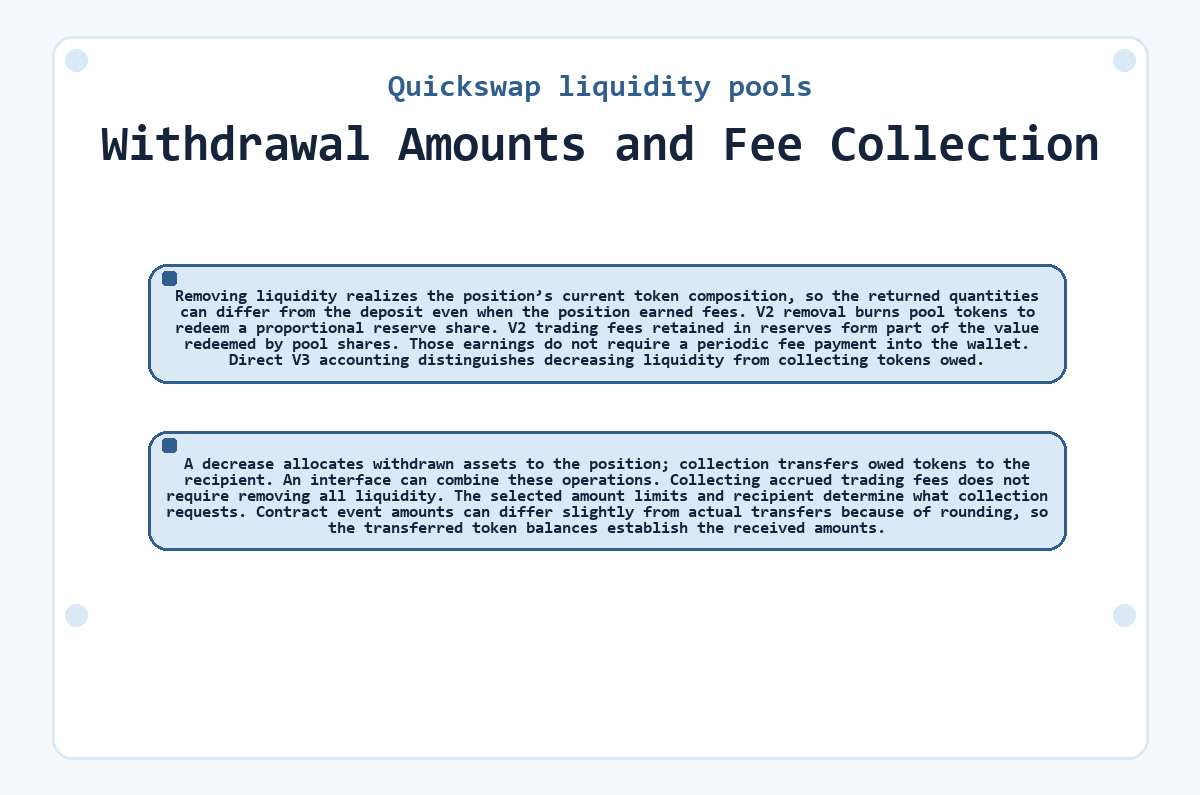
Removing liquidity realizes the position’s current token composition, so the returned quantities can differ from the deposit even when the position earned fees. V2 removal burns pool tokens to redeem a proportional reserve share. V2 trading fees retained in reserves form part of the value redeemed by pool shares. Those earnings do not require a periodic fee payment into the wallet.
Direct V3 accounting distinguishes decreasing liquidity from collecting tokens owed. A decrease allocates withdrawn assets to the position; collection transfers owed tokens to the recipient. An interface can combine these operations. Collecting accrued trading fees does not require removing all liquidity. The selected amount limits and recipient determine what collection requests. Contract event amounts can differ slightly from actual transfers because of rounding, so the transferred token balances establish the received amounts.
Farm Rewards and QUICK Staking
Farm incentives add a separate reward stream for eligible LP positions; an ordinary pool receipt does not automatically enroll a position in every reward program. The farm must support the selected pair and position type. Direct V3 farms can use position NFTs, while managed strategies may use fungible receipts. The reward token and program rules govern that additional income. QUICK staking follows separate reward rules and uses QUICK exposure, so it does not replace liquidity provision. Keep farm reward balances separate from pool trading fees when valuing a farmed position.
Managed Ranges and Rebalancing Costs
Managed V3 liquidity delegates range adjustments to a strategy, allowing the strategy to rebalance positions and compound earnings without the provider manually moving each position. Quickswap’s Gamma integration provides this arrangement for supported pools. Availability belongs to the particular strategy and deployment. Its receipt represents participation in managed liquidity, with the manager determining the underlying range adjustments.
Rebalancing changes the assets held and can add trading or transaction costs. Any management charges also reduce the amount retained by providers. Compounding places earnings back into the strategy, which changes where that value appears. Automatic adjustment leaves exposure to the underlying tokens and contracts in place. A managed strategy’s net value therefore includes its costs and asset composition, alongside the fees that it earns.
LP Receipts Used for Bonds
Quickswap Bonds on Polygon PoS can accept eligible LP tokens or specified assets in exchange for a vesting token allocation represented by an NFT. ApeBond powers this product. Liquidity Bonds accept eligible LP tokens, with a supported Zap offering a single-token purchase route. Reserve Bonds use a single asset. These arrangements exchange the supplied assets for a bond claim, changing how and when the holder receives value.
A bond discount varies with supply and demand, and a lower purchase price can still lead to a loss. Tokens vest over the bond’s term, so the remaining claim follows its schedule. Bonding LP tokens changes the exposure from holding a pool receipt to owning the bond allocation. Trading-fee assumptions from the original liquidity position do not describe the token allocation represented by a Quickswap Bond NFT.
What to know about Quickswap liquidity pools
-
Can I Transfer V2 LP Tokens Without Withdrawing My Liquidity?
- V2 LP tokens can move between wallets while the underlying liquidity remains in the pool. The tokens represent the claim on the reserves, so transferring them also transfers that claim. This differs from sending one of the underlying assets or removing liquidity. Any receipt committed to a farm remains subject to that farm’s withdrawal arrangements.
-
Why Can an LP Receipt Disappear From My Wallet After a Farm Deposit?
- A farm deposit can move the receipt into the farming contract while the underlying pool position remains intact. Direct V3 farming can use the position NFT, and V2 farming can use pool tokens. The farm’s deposit record identifies the committed position. A missing wallet receipt alone does not establish that the liquidity has been removed.
-
Is It Possible to Open a Direct V3 Position With Only One Token?
- A direct V3 position can contain a single token when its price range lies entirely on one side of the current pool price. That position earns no swap fees until the price enters its range. A range surrounding the current price generally requires both assets in proportions determined by that price and the selected bounds. Managed strategies can have different deposit requirements.
-
How Does Creating a New Liquidity Pool Affect Its Starting Price?
- A new liquidity pool needs an initial token price to support trading. For V2, the first deposit’s token ratio sets the reserve-based price; direct V3 pool creation requires an initial price before depositing liquidity. A price that differs from the external market creates an arbitrage opportunity. Adding liquidity to an existing pool follows its established price and deposit requirements.
-
Do LPs Receive Fees From Another Pool Trading the Same Token Pair?
- An LP position receives trading fees from swaps that use its pool’s eligible liquidity. A shared token pair does not combine fees across different pool contracts or deployments. Routing can select other liquidity for a trade. Pair-wide activity therefore cannot substitute for the volume that actually reaches the position’s pool and, for V3, its active range.
-
Which Token Pays Network Fees for Polygon PoS Liquidity Transactions?
- Polygon PoS uses POL for network fees. An eligible MetaMask gas included transaction can charge another supported token when Smart Transactions and Estimate balance changes are enabled. During confirmation, the wallet displays its selected payment token and estimated network charge, including a small MetaMask fee.
-
What Can Reduce an LP’s Estimated APR While Swaps Continue?
- An LP’s estimated annual percentage rate can fall when its share of eligible fees shrinks or the estimator’s other inputs change. Additional active liquidity can divide fees among more providers. Swap charges, trading volume, incentive distributions, and reward-token prices can also change. An annualized estimate describes its calculation period and assumptions; it does not fix future earnings.
-
Does Disconnecting a Wallet Revoke the Allowance Used for a Liquidity Deposit?
- Disconnecting a wallet leaves its on-chain token allowances in place. An allowance applies to the specified token and spender, even after the connection ends. Revocation changes that permission through an on-chain transaction and has a network cost. Revoking an underlying-token allowance does not itself remove liquidity that the provider already deposited into the pool.